

Industry news


View: 278

Release time:2026-04-15
LED video walls have transformed live events, retail spaces, and immersive environments. They deliver unmatched brightness, seamless scalability, and creative flexibility. However, behind every impressive installation lies a set of recurring challenges that many buyers underestimate.
If you plan to invest in an LED wall—or already work with one—you need to understand where projects typically fail. More importantly, you need to know how to prevent those failures.
1. Skilled Labor Shortage: The Industry’s Weakest Link
The LED industry does not suffer from a lack of technology. Instead, it struggles with a lack of skilled operators and technicians.
In many real-world setups:
Crews rely on temporary stagehands
Installers lack LED-specific training
Teams make avoidable mistakes during assembly
As a result, even high-end systems can perform poorly.
Why this matters:
LED walls require precise handling:
Panel alignment
Data and power routing
Calibration and mapping
One mistake can lead to:
Dead pixels or damaged modules
Visible seams
Signal issues
How to solve it:
Work with trained LED technicians—not general labor
Standardize installation procedures
Invest in basic crew training
2. Poor Planning and Communication
Many LED issues start long before installation. Teams often fail to define:
Exact screen dimensions
Panel count and layout
Signal flow and resolution mapping
Without clear planning, crews improvise on-site—and that leads to chaos.
Common symptoms:
Panels installed in the wrong order
Incorrect resolution configuration
Last-minute structural adjustments
Solution:
Treat LED walls like engineered systems:
Create detailed build plans
Predefine signal routing
Align content resolution with screen resolution
3. Structural and Rigging Risks
An LED wall is not just a display—it is a load-bearing structure.
When teams ignore engineering fundamentals, they create serious risks:
Unstable ground support
Insufficient ballast
Improper load distribution
These mistakes can lead to:
Structural failure
Panel damage
Safety hazards
Critical factors to evaluate:
Weight per square meter
Center of gravity
Wind load (for outdoor setups)
Riser or ground support capacity
Solution:
Use certified rigging systems
Follow load calculations strictly
Never “eyeball” structural decisions
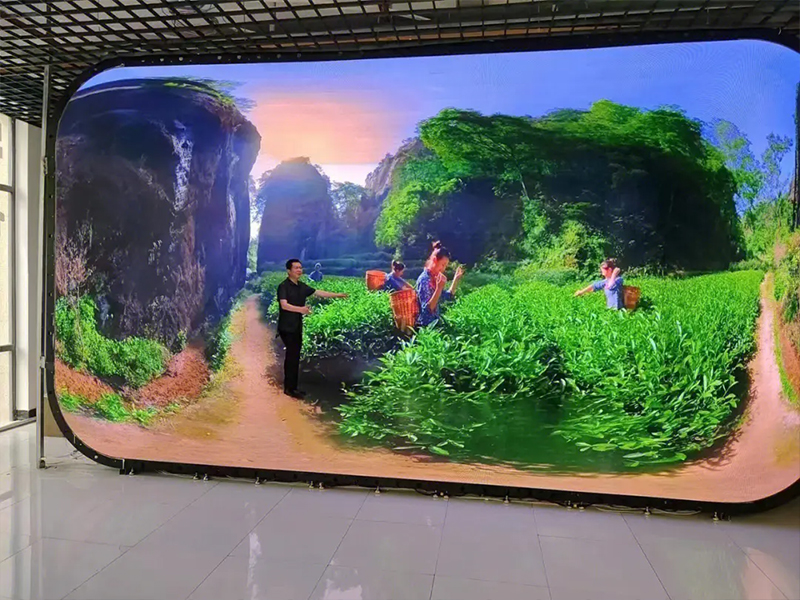
Many users expect LED walls to perform like high-end monitors. In reality, LED technology behaves differently—especially in low brightness and gradient scenarios.
Common issues:
Gradient banding (visible color steps)
Poor black levels
Washed-out colors
Root causes:
Low bit depth (8-bit signal pipelines)
Grayscale limitations
Excessive brightness reduction
Outdoor screens used indoors
Example:
When you reduce brightness on an outdoor LED wall, you also reduce available grayscale levels. This leads to visible banding in dark scenes.
Solution:
Use 10-bit or 12-bit signal pipelines
Avoid excessive brightness reduction
Match screen type to application (indoor vs outdoor)
Ensure proper calibration
Hardware has improved rapidly, but control software often lags behind.
Users frequently report:
Complicated interfaces
Limited flexibility
System instability
Poor cross-platform support
This creates friction during:
Setup
Content mapping
Troubleshooting
Solution:
Choose systems with intuitive control software
Standardize your processing workflow
Test configurations before deployment
LED walls do not automatically “fix” resolution issues. When input resolution does not match the display:
The processor must scale the image
Gradient precision decreases
Artifacts become visible
Typical mistake:
Sending 720p content to a 1080p LED wall
Result:
Blurry visuals
Banding in gradients
Loss of detail
Solution:
Use pixel-to-pixel mapping whenever possible
Match content resolution to LED resolution
Configure processors correctly
Many LED products look great on paper but fail in real environments.
Common complaints:
Panels are fragile during handling
Cabinets cannot be placed safely on the ground
Connectors are hard to access
Maintenance is complicated
These issues slow down installation and increase risk.
Solution:
Look for field-friendly design:
Durable cabinet structure
Front and rear maintenance access
Easy locking systems
Logical cable routing
8. Market Fragmentation and Confusing Purchasing Process
Unlike standardized AV equipment, LED walls often require:
Custom configurations
Multiple vendors
System integration expertise
Buyers face:
Inconsistent specifications
Lack of transparency
Difficulty comparing products
Solution:
Work with experienced suppliers
Request complete system specifications (not just panel specs)
Evaluate full solutions, not individual components
The industry offers:
High-end systems (excellent but expensive)
Low-cost systems (affordable but limited)
However, many buyers need something in between:
Reliable performance
Reasonable pricing
Professional usability
This gap creates frustration and forces compromises.
LED video walls are powerful tools—but they are not plug-and-play displays. Most problems do not come from the technology itself. They come from how people design, install, and operate the system.
Across the industry, the same pattern repeats:
The biggest problems in LED video walls are not hardware limitations—they are system-level challenges.
To succeed, you must focus on:
Skilled execution
Proper planning
Engineering discipline
Workflow optimization
When you address these factors, an LED wall stops being a risk and becomes a reliable, high-impact visual system.
 +86 18688923792
  andy@tosled.com