



Industry news


View: 233

Release time:2026-05-14
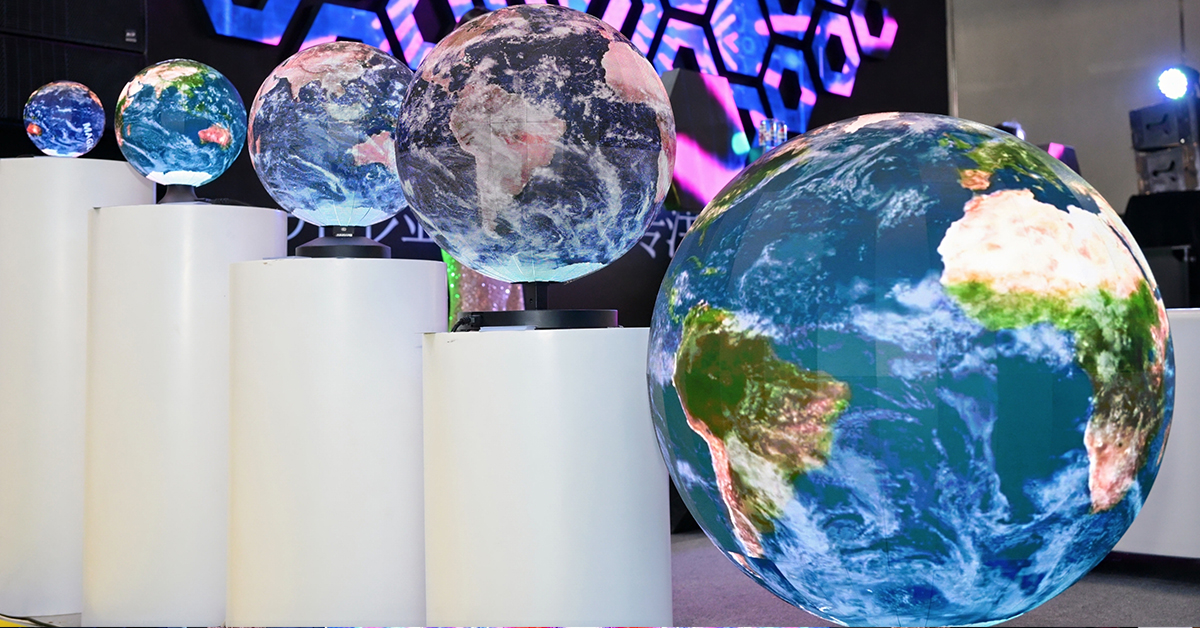
Achieving uniform brightness on a spherical LED display is far more difficult than on a conventional flat screen. A sphere introduces continuous multidirectional curvature, changing both the physical arrangement of the LEDs and the viewer’s perception of brightness from different angles.
Without proper engineering, spherical LED screens can easily suffer from:
brightness inconsistencies
visible seams
dark transition zones
edge luminance drop
uneven color perception
To create a visually smooth 360° display, manufacturers must combine structural precision, optical calibration, pixel mapping, and content optimization.
Below are the key technologies used to ensure brightness uniformity across a spherical LED screen.
The foundation of brightness uniformity starts with the module structure itself.
Spherical LED displays usually avoid traditional rectangular panels and instead use:
hexagonal modules
honeycomb-style modules
miniature irregular-shaped LED units
Typical module sizes include:
160 mm
smaller customized formats
These smaller modules naturally fit curved spherical geometry more accurately.
As a result, they reduce:
uneven surface transitions
angular shadow zones
structural gaps
edge brightness discontinuities
Because the modules follow the sphere more closely, the emitted light distributes more evenly across the surface.
Smaller modules also help maintain consistent viewing angles between neighboring pixels, which improves perceived luminance uniformity.
Mechanical precision plays a major role in optical consistency.
Modern spherical LED displays often use:
lightweight carbon-fiber spherical frameworks
precision curved cabinets
dedicated spherical locking systems
These structures allow engineers to keep module gaps extremely small.
High-end systems typically control seam width within:
0.3 mm or less
This minimizes:
black seam visibility
brightness interruption
edge light leakage
transition shadowing
If seams become too large, the human eye immediately notices brightness breaks across the sphere.
Therefore, physical assembly accuracy directly affects visual uniformity.
Even with excellent hardware alignment, spherical displays still require advanced digital correction.
Why?
Because LEDs mounted on a sphere do not face viewers at identical angles.
This creates natural luminance variation across different regions of the sphere.
To compensate, engineers build a full 3D digital model of the display.
The control system then generates:
nonlinear LUT mapping tables
geometric correction algorithms
brightness compensation matrices
These systems dynamically adjust pixel output based on:
surface curvature
viewing angle
spatial position
For example:
edge pixels may receive brightness compensation
polar regions may undergo luminance balancing
stretched pixel zones may receive gain adjustments
As a result, brightness transitions appear smooth and continuous around the entire sphere.
Professional spherical LED displays usually undergo full pixel-level calibration.
Using industrial cameras and calibration software, engineers measure:
luminance consistency
chromaticity variation
low-gray response
inter-module brightness deviation
The system then generates calibration coefficients for every pixel.
This process compensates for:
LED manufacturing tolerances
brightness drift
color inconsistencies
viewing-angle variation
Because spherical displays contain continuously changing angles, this calibration process becomes even more important than on flat screens.
Without calibration, the sphere may show:
visible brightness bands
uneven hemispheres
hotspot regions
dark polar zones
Content design also affects perceived brightness uniformity.
Standard flat video content often produces uneven visual balance when mapped onto a sphere.
For example:
polar regions may appear stretched
image density changes across the surface
brightness concentration may become uneven
Therefore, professional spherical display projects create media specifically for:
360° spherical environments
Content teams use:
equirectangular rendering
panoramic animation workflows
spherical projection pipelines
to ensure visual energy distributes evenly across the sphere.
Balanced content design helps avoid localized over-bright or under-bright regions.
Uniform brightness also depends on maintaining continuous LED coverage across the entire sphere.
Manufacturers therefore use:
full-wrap module layouts
continuous circumferential coverage
complete polar filling
No blank reserve zones remain at:
the top pole
the bottom pole
equatorial transitions
This prevents sudden luminance breaks or dead visual areas.
Combined with front-service modular maintenance systems, engineers can preserve full coverage while still allowing practical servicing access.
Spherical displays introduce a unique optical challenge:
Different parts of the sphere face viewers at different angles simultaneously.
This affects:
perceived brightness
contrast
color saturation
To improve consistency, manufacturers optimize:
LED viewing angle distribution
diffusion layer design
optical encapsulation structure
Some advanced systems even apply:
multi-angle brightness compensation LUTs
dynamic gamma adjustment
regional luminance balancing
These techniques help stabilize brightness perception from multiple viewing positions around the sphere.
The key principle is straightforward:
Smaller modules create smoother optical transitions.
As module size decreases:
curvature approximation improves
seam visibility decreases
angle variation becomes more gradual
brightness transitions become smoother
That is why modern spherical LED displays increasingly rely on:
miniature modules
honeycomb structures
customized irregular cabinets
rather than large conventional flat panels.
 +86 18688923792
  andy@tosled.com