

Industry news

View: 353

Release time:2026-06-09
When engineers design a custom, M-shaped LED display with animated elements—such as moving eyes—they face two primary hurdles: structural customization and precise pixel mapping. To ensure the final animation moves fluidly without any visual distortion, designers must carefully execute five critical engineering requirements.
Because the letter "M" features sweeping arches at the top and sharp angles in the center, standard rectangular LED panels simply will not work.
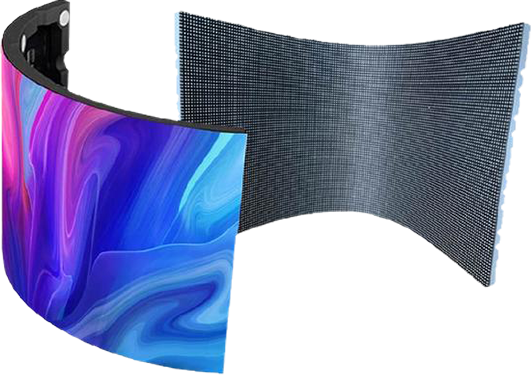
Deploying Flexible LED Modules: Technicians use flexible, rubber-backed LED modules (often called soft modules) to wrap smoothly around the curved crests of the "M."
Custom Corner Cutting: For the sharp inner V-shape, factory workers cut the modules at precise angles (such as 45-degree miter joints). This technique eliminates gaps and prevents unsightly black lines where the panels meet.
Laser-Cut Support Framework: Fabricators use laser-cut sheet metal or aluminum to build a rigid, bespoke frame. This precise housing guarantees that the outer contour of the "M" remains perfectly crisp and smooth.
To make the eyes move naturally without breaking apart at the edges, engineers must align the physical layout with the digital video file.
Custom Routing: Unlike standard rectangular screens, an M-shaped display has a non-linear grid. Therefore, control engineers must manually route the data cables and map out a custom data path using software like Novastar or Colorlight.
Importing CAD Blueprints: Software programmers import the exact CAD drawings of the letter into the LED control system. Consequently, the computer learns exactly where the screen's boundaries lie. If a technician skips this step, the eye animation will warp or distort the moment it rolls toward the edge of the letter.
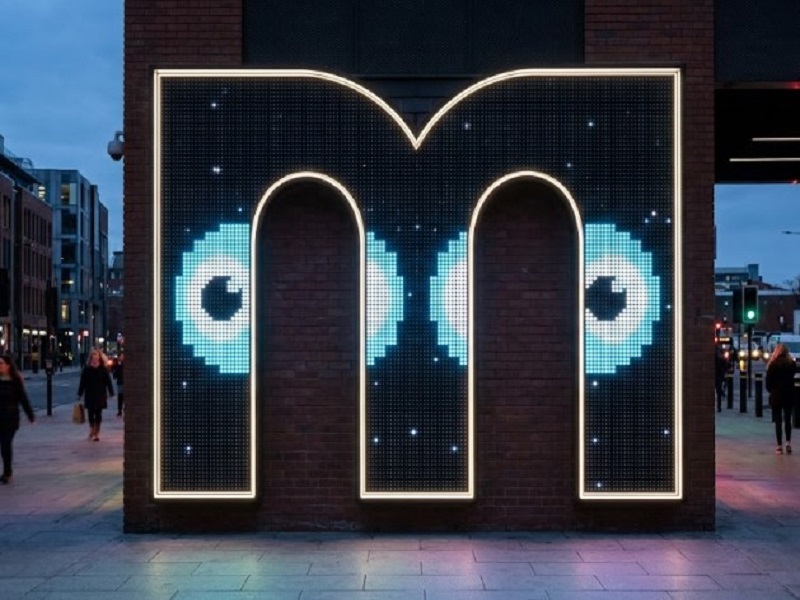
The illusion of floating, moving eyes relies heavily on clever content creation rather than complex hardware tricks.
Utilizing Pure Black Fields: Animator create the video asset using a standard rectangular canvas that completely encompasses the "M." Crucially, they render everything outside the eyes as pure black ($0, 0, 0$ in RGB). Because LED pixels emit no light when displaying true black, the background completely vanishes at night, leaving only the glowing letter outline and the moving eyes visible to the public.
Injecting 3D Depth: To make the eyes look like they are rotating deep inside the structure, motion designers use software like Blender or After Effects to add realistic shadows and perspective. This 3D depth makes the eyeballs look like rolling spheres instead of flat, sliding 2D shapes.
If the moving eyes judder, lag, or show scan lines on camera, the installation will look cheap and unprofessional.
Demanding High Refresh Rates: Hardware specifiers must select high-refresh-rate driver ICs. This choice ensures that when pedestrians take photos or record videos with their smartphones, the eye movement looks buttery smooth and completely free of flickering.
Choosing the Right Pixel Pitch: Project managers select the pixel pitch based on the viewing distance. For close-up indoor viewing in a mall, engineers typically choose a tight P2 or P2.5 pitch. Conversely, for outdoor, street-facing displays, a P3 or P4 pitch suffices. A tighter pitch reduces the "pixelation" effect, making the edges of the eyes look incredibly sharp.
The unique geometry of the letter "M" creates narrow structural pockets that trap heat and restrict physical access.
Passive Aluminum Cooling: Because the narrow midsection of the "M" cannot accommodate bulky cooling fans, engineers rely on the aluminum frame itself to dissipate heat. Additionally, they cut discrete ventilation slots at the very top and bottom of the frame to encourage natural air convection.
Implementing Front-Access Magnetic Modules: Since these displays usually mount directly flush against a wall, technicians must design them for front-side maintenance. By using magnetic modules, a technician can easily pop out a damaged panel from the front using a suction tool, making repairs incredibly swift and straightforward.
Ultimately, successful deployment requires teams to reverse the traditional construction order. Instead of building the frame first, engineers must follow a strict, top-down workflow: Lock in the animation concept ➔ Map the pixel matrix ➔ Generate the CAD schematics ➔ Manufacture the custom modules ➔ Calibrate the software.
 +86 18688923792
  andy@tosled.com