


News
Most genuine customer feedback, highly informative technical support videos, and our latest updates!
Most genuine customer feedback, highly informative technical support videos, and our latest updates!

View: 10

Release time:2026-09-26
These differences are often difficult to notice during a quick factory inspection.
For fine-pitch indoor projects, however, they can become very visible after installation.
This is why COB LED display surface uniformity testing should be completed before shipment, especially for meeting rooms, control rooms, studios, showrooms, and other close-viewing applications.
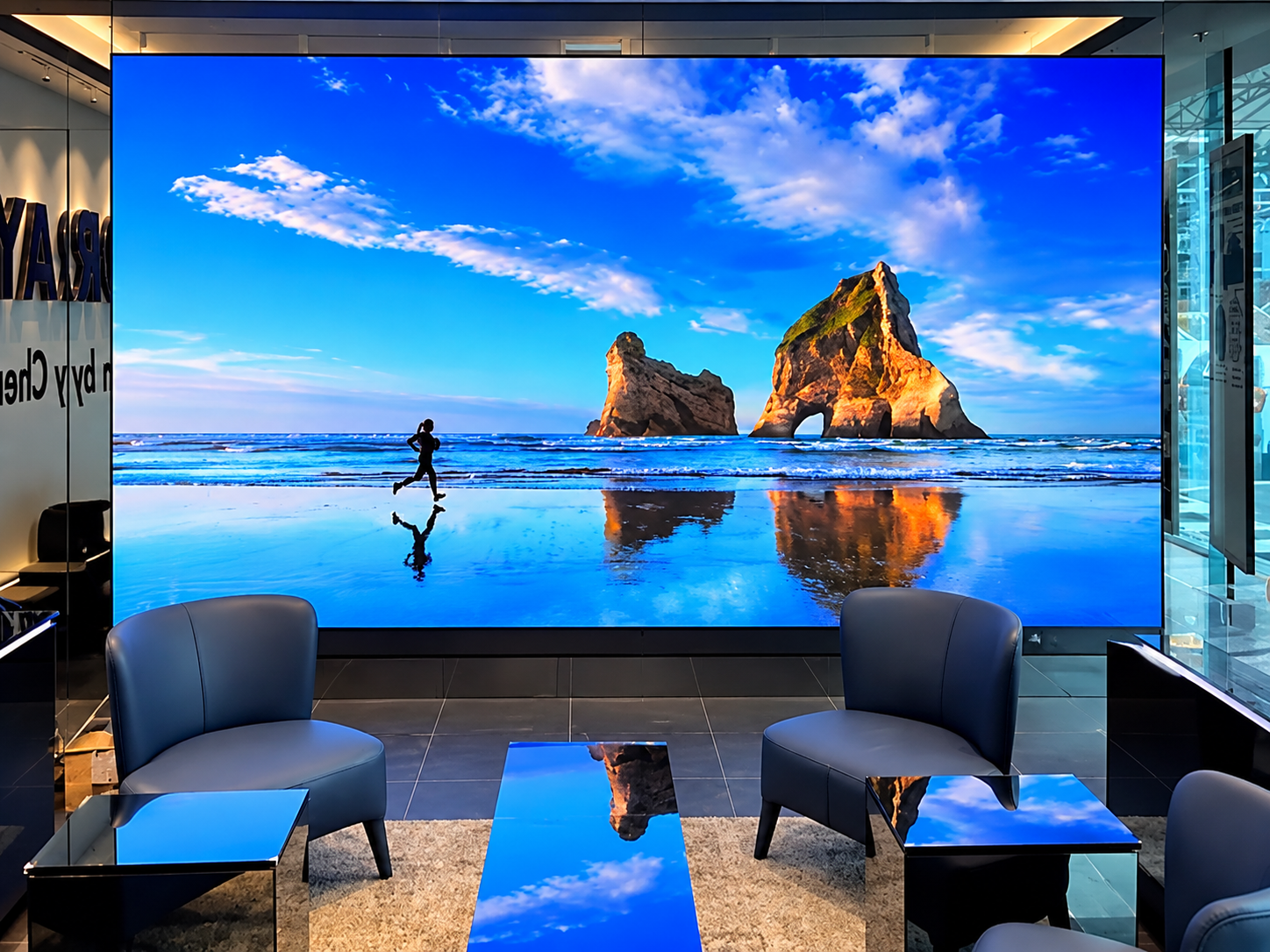
COB technology places LED chips directly onto the PCB and protects them with an encapsulation layer.
This structure gives the screen a smoother surface and stronger protection against physical impact, dust, and moisture compared with many conventional fine-pitch structures. TOOSEN's current COB products are designed for fine-pitch indoor applications and include options such as P0.6, P0.7, P0.9, P1.2, P1.5, and P1.8.
However, a smooth surface does not automatically mean every part of a large video wall will look identical under all lighting conditions.
Surface inconsistency may become noticeable when:
the screen displays black or dark gray content;
brightness is reduced;
strong ceiling lights hit the screen;
viewers stand close to the display;
the screen is viewed from an angle;
different production batches are mixed.
For premium indoor projects, these small differences can reduce the visual quality of the complete wall.
The problem is not always caused by the LEDs themselves.
Several factors can affect the final appearance.
The protective surface over the LED chips needs consistent thickness and optical properties.
If different modules have small differences in surface treatment, they may reflect ambient light differently.
The screen may therefore look uniform when powered on but uneven when switched off.
Modules produced from different material batches can have small differences in black level, surface texture, or optical response.
Individually, each module may pass inspection.
After several modules are installed together, however, the boundaries can become visible.
Sometimes the surface material is not the real problem.
If one COB module sits slightly higher or lower than the surrounding modules, overhead lighting will hit it at a different angle.
This creates a visible bright or dark area.
For this reason, surface inspection should be combined with a cabinet flatness check.
TOOSEN's COB series specifies high-precision cabinet structures and flatness control for seamless splicing, making mechanical alignment an important part of final inspection.
A common inspection mistake is running colorful videos or a 100% white screen and deciding that the display is acceptable.
Bright content can hide many small inconsistencies.
A better COB LED display acceptance test should use several test patterns.
Start with:
100% black
Check the screen while powered on and also inspect the physical surface when the LEDs are not producing visible light.
Look for module-to-module changes in surface darkness or reflection.
5% to 10% gray
This is one of the most useful tests.
Low-gray images can reveal mura, uneven brightness, calibration differences, or patches that cannot be seen in bright video.
30% to 50% gray
A middle-gray image makes larger uniformity differences easier to compare across the complete screen.
Full white
Finally, use white content to check overall brightness consistency, color temperature, and obvious module boundaries.
There is another simple test that is often ignored.
Do not inspect the COB screen only under normal front lighting.
Place a light source above or to the side of the display and observe the surface from different positions.
Walk from the center toward the left and right sides.
If one module suddenly appears brighter because it reflects more light, record its position.
This test is especially important when the final screen will be installed in a conference room, retail store, showroom, or reception area with strong ceiling lighting.
The goal is not to eliminate all reflection.
The goal is to make sure reflection behavior is reasonably consistent across neighboring modules.
If an uneven area is found, avoid simply saying:
“Upper-left area looks different.”
Use a module or cabinet coordinate.
For example:
Cabinet C3 – Module R2C4
Then compare the suspect module with modules around it.
You can also exchange its position with another module.
If the visual difference moves with the module, the cause is likely related to that module.
If the difference stays in the same physical location, check cabinet flatness, mounting pressure, structure alignment, or lighting angle.
This simple swap test can prevent unnecessary replacement of good modules.
A COB LED screen is a complete system, not only a light-emitting surface.
Module precision, cabinet flatness, receiving cards, power supplies, calibration data, thermal conditions, and installation accuracy all affect final image quality.
TOOSEN's COB LED display range includes fine-pitch indoor solutions with front-service structures, high refresh rates, compact cabinets, and low-power designs for conference rooms, control rooms, exhibition spaces, retail environments, and other close-viewing applications.
For these projects, uniformity inspection should therefore be completed after modules are installed into the final cabinets rather than testing loose modules only.
Consider a fine-pitch COB LED video wall installed in a corporate meeting room.
During factory playback, promotional video and presentation slides look normal.
During the final acceptance test, engineers switch the screen to 5% gray.
Two modules become slightly darker than the surrounding area.
After exchanging their positions, the dark areas move with the modules.
This confirms that the issue is module-related rather than a cabinet alignment problem.
Replacing those modules before shipment is much easier than solving the same problem after the video wall has been installed overseas.
No.
Calibration can correct many brightness and color differences, but it cannot completely solve physical surface reflection, encapsulation differences, or mechanical flatness problems.
Yes.
A powered-off inspection can reveal differences in surface color, texture, gloss, and reflection that bright content may hide.
Low-gray images reduce the masking effect of high brightness. Small differences between modules become easier to see, especially on fine-pitch displays viewed at short distances.
When possible, yes. Using matched spare modules can reduce visible differences in surface appearance and optical performance.
A high-resolution COB LED display should not be accepted only because it can play a bright video without dead pixels.
Surface consistency, low-gray uniformity, cabinet flatness, reflection behavior, and module matching should also be checked before shipment.
TOOSEN provides COB LED display solutions for fine-pitch indoor applications and supports product selection, cabinet configuration, factory testing, installation planning, and technical support.
For projects where viewers will stand close to the screen, adding a COB surface uniformity test before shipment can prevent small factory differences from becoming obvious problems at the final installation site.
 +86 18688923792
  andy@tosled.com