

Industry news


View: 680

Release time:2026-05-26
The playback method depends on whether the system uses synchronous or asynchronous control.
Synchronous Playback Workflow
In synchronous mode, the LED screen functions like an external monitor.
Typical Process
The computer outputs video through HDMI or DVI.
The sending card receives the signal.
The sending card transmits data through Ethernet cables.
Receiving cards decode the data.
LED modules display the image in real time.
This process creates seamless live playback with millisecond-level latency.
Common Software
Popular synchronous playback software includes:
NovaStudio
Resolume
Watchout
LED Studio
These platforms support advanced visual effects, live switching, and multi-screen management.
Asynchronous Playback Workflow
Asynchronous systems use dedicated media players instead of constant live input.
Typical Process
Upload content through USB drive or network.
Store media files inside the playback box.
Create playlists and schedules.
The player automatically loops content according to the timetable.
This method greatly simplifies daily operation.
Popular LED Control Software Platforms
Different LED control brands provide their own software ecosystems.
Brand | Software | Main Advantage |
NovaStar | NovaLCT / ViPlex | High stability and strong market adoption |
Colorlight | LEDVision / iSet | Cost-effective and user-friendly |
Huidu | HDPlayer / HDSet | Strong asynchronous control solutions |
Linsn | LEDStudio | Long-established compatibility |
Kystar | Kommander | Professional stage control |
Onbon | Ledshow | Common for storefront and single-color displays |
How to Configure an LED Screen Step by Step
Although different brands use different interfaces, the general setup process remains similar.
Step 1: Hardware Connection
First:
Install the sending card driver
Connect the sending card to the first receiving card
Daisy-chain additional cabinets through Ethernet cables
Large projects may also use fiber optic transmission for long-distance signal delivery.
Step 2: Configure Screen Parameters
Inside the control software, configure:
Screen resolution
Cabinet arrangement
Module dimensions
Scan mode
Signal routing
Common scan configurations include:
1/8 scan
1/16 scan
Correct mapping ensures proper image alignment across the entire display.
Step 3: Upload and Play Content
After setup:
Add videos or images to the playlist
Configure playback modes
Set loops, schedules, or triggers
Start playback
The content immediately appears on the LED screen.
Step 4: Adjust Brightness and Calibration
Proper brightness calibration improves both image quality and LED lifespan.
Operators usually:
Increase brightness during daytime
Reduce brightness at night
Enable automatic brightness sensors
Use pixel-level calibration
Calibration removes color inconsistency and improves screen uniformity.
Advanced LED Display Control Solutions
Modern LED projects often require more sophisticated control architectures.
Multi-Screen Synchronization
Large installations frequently combine multiple LED screens into one unified visual canvas.
Video processors or distributed systems synchronize:
Multiple LED walls
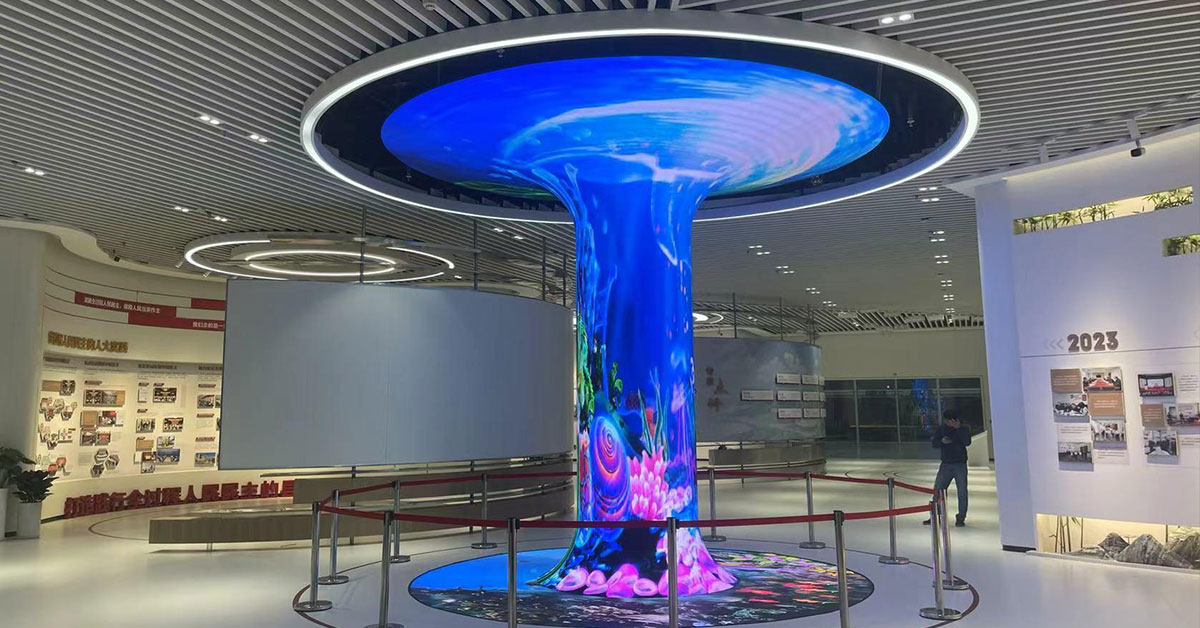
Curved displays
Ceiling screens
Architectural media facades
Interactive LED Systems
Interactive installations integrate additional devices such as:
Motion sensors
Radar sensors
Touch systems
Kinect cameras
Central control systems
These technologies allow users to interact directly with LED content through gestures or movement.
Remote Cloud Management
Cloud platforms combined with 4G or 5G networks allow operators to:
Update content remotely
Monitor device status
Receive fault alerts
Adjust brightness remotely
Control multiple cities from one dashboard
This capability dramatically reduces maintenance workload for large digital signage networks.
Recommended LED Control Solutions by Application
Different projects require different control architectures.
Application | Recommended Solution |
Indoor conference room | Synchronous control + video processor |
Outdoor billboard | Asynchronous player + automatic brightness adjustment |
Stage performance | Professional media server + backup redundancy |
Chain retail stores | Cloud management system + 4G asynchronous controller |
Conclusion
LED display playback and control systems combine hardware, software, and network technology into one integrated platform. From small storefront signs to massive stage LED walls, the right control architecture determines image quality, operational stability, and maintenance efficiency.
Synchronous systems excel in real-time environments, while asynchronous systems simplify unattended advertising playback. Meanwhile, cloud-based control platforms continue transforming how operators manage large-scale LED display networks remotely.
As LED technology advances, control systems are becoming smarter, faster, and increasingly connected, giving businesses more flexibility in content management and visual communication.
 +86 18688923792
  andy@tosled.com